Crispy hash browns

Time saver: fried potato with salt and pepper, oh yeah…
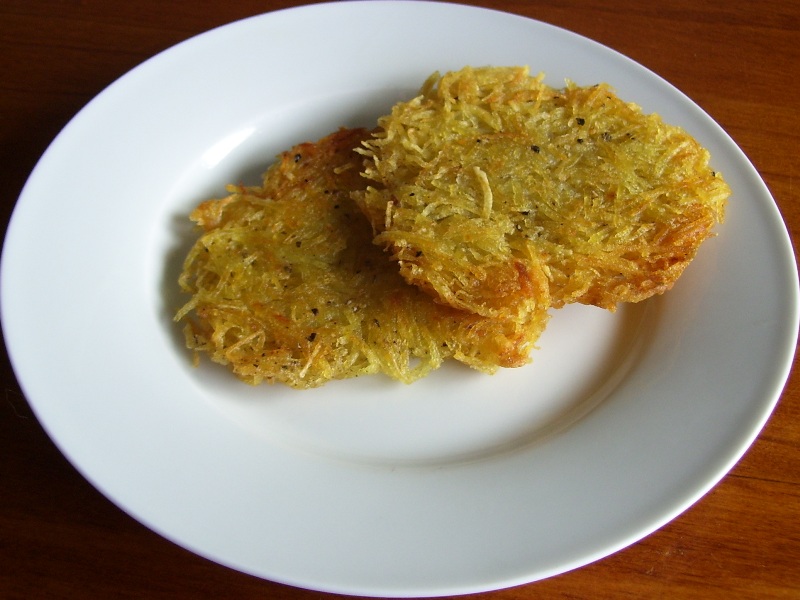
Crispy hash brownsI’m not really sure if it’s the right time to post this recipe. I think the recipe’s good, but my technique is not quite there yet. I made these the other night, but forgot I’d used my oil and ended up having to cook them in peanut oil. (I probably wouldn’t have normally picked that in particular.) As a result I didn’t quite get the golden-brown finish I would have liked. They’re still good and crispy though. Anyway, I’ll put the recipe out there and reserve the right to tweak it and upload photos later on. (UPDATE: photo uploaded from subsequent attempt.)

There’s two basic types of hash brown – the pure hash brown and the embellished one. The first is simply grated potato, seasoned with salt and pepper, fried in a little oil. The second might contain eggs (which help hold everything together), onions, garlic, bacon etc. This post is all about the pure version.

The key thing for a good crispy hash brown is to get as much moisture out of the grated potatoes as possible. There are a few different ways to achieve this, how you do it will really come down to personal preference and what you’ve got available. Just as indication, the potatoes I used went from weighing 600g immediately after grating, to weighing about 400g with the moisture extracted. (And it’s possible I could have got more out.)

Techniques for extracting moisture:

  • Put grated potato in a colander, press firmly to squeeze out moisture. Leave for 20 minutes or so, then squeeze again. A variation on this is to also sprinkle a little salt in after the first squeeze to help draw out more moisture.
  • As per the colander, but use a metal sieve (just be careful not to break it – you really do have to push quite hard to get that moisture out).
  • If you don’t have a sieve or a colander, just leave the grated potato in a large bowl. Squeeze the potato to one side and pour out the liquid. Again, leave for 20 minutes, then repeat. (You’ll be surprised how much more liquid accumulates after the wait.)
  • You can use a potato ricer to squeeze out the moisture directly. If you haven’t seen one it’s basically like a large garlic press, usually used for mashing potato. In this case you press the grated potato in the ricer and squeeze the liquid out. (The idea is not to push the potato through the ricer – just to get rid of the moisture.)
  • You can try using paper towels to blot off the moisture, or wrap around some of the grated potato and squeeze it out. Note that you’ll probably have to use a lot of paper towels to do this properly.
  • If you have an extremely clean tea towel handy you can pile the grated potato into the middle, fold the towel around it lengthwise, then twist it thoroughly, wringing the moisture out of the potato.
  • Or let your imagination take flight (and let me know in the comments what you do!).

Crispy hash browns – makes eight 50g hash browns

  • 600g potato (this is about 4 medium sized potatoes), starchy varieties work best (but use what you have)
  • freshly ground black pepper
  • salt
  • oil/butter (or a combination) for frying
  1. Clean and dry the potatoes. You can peel them, but I leave the skins on (since that’s where the nutrients are). Remove any obvious blemishes, eyes, shoots etc.
  2. Grate the potatoes into a large bowl. Pick one of the moisture extraction techniques listed above and get as much moisture out of the grated potato as possible.
  3. Season the potatoes with freshly ground black pepper, and stir it through.
  4. Heat 2 Tbsp oil in a frying pan on a medium-high heat. It needs to be quite hot before you add the potato…
  5. Scoop the grated potato into a ¼ cup measure and press it in firmly, then tip into the frying pan. (You can just spoon the potato into the pan, but using the ¼ cup measure ensures even sized hash browns and helps keep the potato together. For a bigger hash brown use a bigger measure.) Press the hash brown down with the back of a spoon, spreading the potato out and getting to about ½ – 1 cm thick. Try and keep the edges together (the grated potato tends to stray outwards). After pressing it flat, sprinkle/grind a little salt over it. You’ll probably fit about 3 or 4 hash browns in the pan at a time (unless it’s a big pan).
  6. Fry the hash brown for around 3-4 minutes, then flip and fry for around 3-4 minutes on the other side. If the oil has all been absorbed you can add a little more just prior to flipping. The exact cooking time will obviously depend on your element, frying pan, potato, oil etc. Ideally the hashbrowns should be golden-brown (without going actual brown), and need to be cooked all the way through.
  7. Serve and eat while hot.

Measuring cheese

Time saver: Phil rants about  measuring cheese. No really.

Helpful tip: if you genuinely came here hoping to find out how much cheese to use because someone’s failed to take the advice of yours truly and specified the quantity by volume rather than weight, this may help. As a rough guide, 1 cup of grated cheese is equal to around 125g (which is 0.27 lbs or 4.4 oz). That holds for mozarella and cheddar anyway, good luck with anything else.

So tonight I got back from a kayak rolling session at the pool (after four months off – BOOM still got it) and felt like a bit of a snack. I decided I’d try out my tuna melt parcels again, cooking off the recipe to make sure I’d gotten it right. And, well I mostly had – I’ve updated that recipe with a couple of minor changes, and I’ve got a few more photos to clarify a couple of steps – but then I got to the cheese.

It turns out that measuring cheese by grated volume is insane. As in, completely crazy, utterly wrong-headed and extremely unhelpful. It just doesn’t work. It’s so bad that not only did I immediately vow to never post a recipe with the cheese measured by volume again, I decided I should go back and fix up all of my old recipes as well. (This will happen as I go back and cook things again.)

I’m actually going to go further than that, and say that no one anywhere should ever specify cheese measured by volume in a recipe. Just don’t do it.

What’s so wrong about it? Well, consider that a recipe essentially has two parts, the list of ingredients (with measurements), and the method. To get the desired product, you measure out the ingredients, and combine them in the way specified. The problem with measuring cheese by volume is that it’s completely arbitrary – it’s impossible to do it accurately, or know quite how much cheese the creator of the recipe actually intends for you to use. If you can’t measure the ingredients correctly, then the chances of you ending up with the result you want are greatly diminished.

Here’s a concrete example, with a recipe for grated cheese:

Grated cheese on a plate

  • 1 c grated cheddar cheese
  1. Put grated cheese on a plate.

Here’s the thing: how much cheese do you now have on the plate? What I found out tonight is that there could be as little as 50g on there, or as much as 150g. While I was making the tuna melt parcels I wanted to measure out a ½ cup of grated cheese. I cut off a 50g chunk of cheddar (I weighed it), then grated it finely. At the end I was left with what looked like 1 cup of cheese – twice as much as the recipe said. So I pushed it down into the ½ cup measure and made it all fit. My full cup of cheese had just turned into a ½ cup. A few nights ago though, I was measuring grated mozarella (grated thickly)  for the New York style pizza and found that about 1 cup was around 125g. But I could have easily pressed in more and taken it to 150g or more. So, depending on how it’s grated, and how aggressively it’s made to fit into the measure, how much cheese ends up on the plate could vary a lot.

Besides that, it’s basically impossible to measure the right quantity as you go anyway. Assuming you’re grating cheese, how do you know when you’ve grated the right amount? Do you keep stopping and checking to see if you’re reached a cup yet, or do you grate a whole lot and then try and stuff it into the measure?

So what’s the solution? It’s simple: specify the amount of cheese by weight. You can write 100g grated cheese into your recipe just as easily as you can write 1 cup grated cheese. Doing it by weight actually ensures that people can measure the right amount, doing it by volume just leaves it to chance. Not only that, but it’s easy to cut off a slab of cheese, weigh it to get the right amount, and then grate it. Try doing that when you’re measuring by volume.

When you consider all of these points, you can’t help but acknowledge that it’s inappropriate to specify the amount of cheese in a recipe by volume. If you consider it a little further it’s hard not to come to the conclusion that people who do specify the amount of cheese by volume do so because they don’t actually know (or care) how much cheese should be used. They’re effectively saying it doesn’t matter, and it’s up to the cook’s discretion, except they don’t actually say that. They’re not only being lazy, they’re also being dishonest.

The next time you see a recipe with cheese specified by volume and not weight, ask yourself why. And then ask the author to fix it.

Cooking frozen croissants

Time saver: Phil responds to popular demand… (later he’ll be offering advice on how to cook toast, make tea, etc.)

OK, so this is a bit of weird one. For some reason though, people are ending up getting directed to my croque-croissant page when they search for “how to make frozen pre cooked croissants”. No kidding.

Because I’m a helpful guy (really) I figure I may as well give the people what they want. So here it is:

Your Guide to Cooking Frozen Croissants (pre-proved and otherwise)

Frozen croissants are essentially awesome. You get to make fresh, hot croissants, without any of the effort of making them. If you use a little imagination you can pretend you spent hours toiling away, preparing the pastry, and folding to perfection. And then you forgot all about it, et voila, beautiful smells and croissants out of the oven.

So, you’ve got hold of some of these frozen delights, but presumably they either didn’t come with instructions, or you lost them. Careless of you, but luckily Phil’s here to save the day.

First off, you need to determine whether your croissants are pre-proved or not. That just means you need to know whether the croissants have been left to rise already, or whether you’re going to have to do it yourself. If the packaging doesn’t say, then the best way to judge is simply by size. Un-risen croissants are surprisingly small compared to their final size. If the croissants look tiny, then you’ll probably have to prove them. If they look croissant-sized, then you won’t. (Note that just to make things fun it’s slightly trickier than that, since you can also buy mini-croissants. You’re just going to have to make a call, but maybe a sign of that would be the sheer number of them.)

For pre-proved croissants you normally don’t even have to thaw them. Just pre-heat the oven to about 180-190°C (355-375°F), then bake the croissants for around 15 minutes, till golden brown.

For the non-pre-proved croissants, you normally just lay them out on an baking tray (lined with baking paper) and leave them to thaw overnight (or for around 8 hours). After thawing they should expand a lot. Be careful not to leave them too long, or they’ll end up collapsing down on themselves. Pre-heat the oven to around 180-190°C (355-375°F) and bake the croissants for around 10-15 minutes, till golden brown.

For both kinds you can improve the appearance of the final product by giving the croissants an egg wash before you put them in the oven. Just whisk one egg together with a tablespoon of water, then brush over the croissants.

Crème brûlée

Time saver: silky smooth deliciousness, topped with crisp toffee – what’s not to love?

I’d had crème brûlée at restaurants a couple of times before, but it wasn’t until I made them myself that I really started to love them. My sister got me a butane gas torch for making brûlée a couple of Christmases ago, and not wanting it to go to waste I thought I’d better try it out. Ever since then I’ve been hooked.

This recipe is really an amalgamation of a few different recipes I’ve come across. I’ve tweaked and adjusted as I’ve gone, and the last time I made it was the best. I’ve tried making it with fewer egg  yolks – even as low as just using 3 – but it definitely works better with more, with a better texture and richer flavour. If you do use fewer egg yolks you’ll need to cook them for longer. I’ve also tried tricks like cutting open a vanilla bean and leaving it in the cream overnight before making it. It certainly didn’t hurt, but I still needed a lot of vanilla extract anyway.

Generally speaking you’d make these the night before you want to eat them. If you really can’t wait, then go ahead and eat them the same day, but make sure you’ve refrigerated them after cooking for at least an hour or so.

One final note: use natural vanilla extract – don’t use artificial vanilla essence, it just isn’t the same. (And since you’re going to the trouble of making this decadent dessert, you’ll want to do it justice.) You can buy it, or make your own by soaking vanilla beans in vodka.

Crème Brûlée – makes 4 custards (fills 4 ramekins of around 150 ml)

  • 500ml cream
  • 6 egg yolks
  • 3 Tbsp caster sugar
  • 1-2 Tbsp natural vanilla extract (depending on strength)
  • Additional caster sugar for topping (around 1½ tsp per rammekin)
  1. Pre-heat oven to 140°C.
  2. Heat cream in a sauce pan over medium heat, stirring constantly. Cream will eventually start to boil, getting very frothy and rising in pan. When this happens, remove the pan from the heat immediately, add the vanilla extract and stir well. (Have a quick taste test to determine if you need to add more vanilla. I typically use 2 Tbsp, even with bought extract.)
  3. While cream is cooling, combine the sugar and egg yolks in a separate bowl, and whisk well. After a couple of minutes the mixture should go a pale yellow.
  4. Pour the (still warm-hot) cream into the egg mixture, whisking as you pour, and mix well.
  5. Distribute the mixture evenly among the four ramekins, then place the ramekins in a small roasting dish, and half-fill the dish with hot water (being careful not to splash your cream).
  6. Put the dish in the oven and cook for around 25 minutes. The centres should be not quite fully set, but a skewer put into the custard about halfway to the centre should come out clean. (You kind of have to use your discretion, and a lot of it comes down to your oven, the size of the ramekins, prevailing wind conditions etc.)
  7. Remove the dish from the oven, and allow to cool. Once they’re cool enough to handle, you can remove the ramekins and put them in the fridge.
  8. When you’re ready to serve, take the custards out of the fridge. Sprinkle a little sugar evenly over the tops of each one (around 1½ tsp or so), then fire up your torch. Move the flame across the surface, melting all of the sugar and caramelising it a little to get a golden brown. It takes a bit of care to make sure you don’t end up burning it, but don’t be alarmed if it’s a little darker than you were expecting.

Five minute artisan bread

Time saver: the bread takes five minutes to make, and you want to save time?? OK, OK, Phil reveals a simple bread recipe that also doubles as a great pizza dough (and keeps for two weeks in the fridge!).

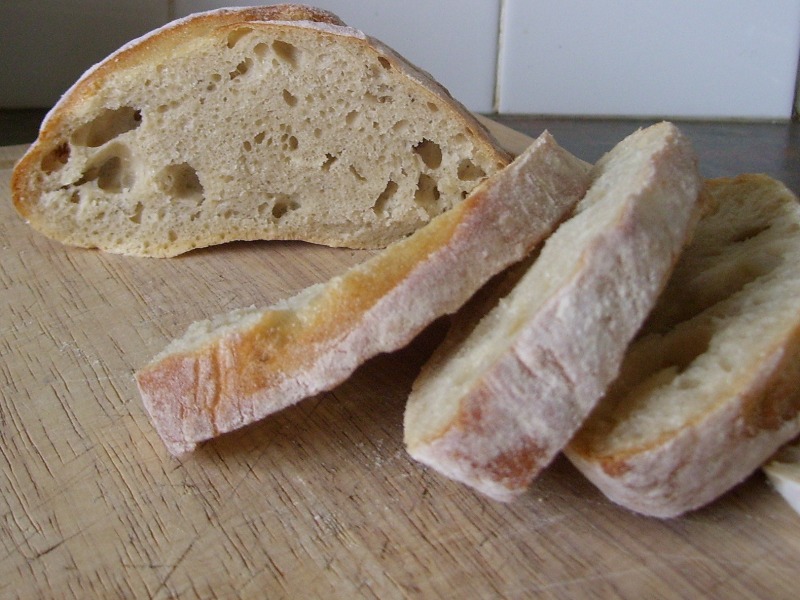
Sliced Artisan LoafWhen Mum last came to visit she raved enthusiastically about a new bread recipe she’d come across and encouraged me to make it. Actually, she’d started raving about it a couple of weeks (months?) before she arrived, so when she did she brought the ingredients with her and whipped up a batch in no time. And just as she’d claimed, the results were pretty impressive.

Mum didn’t invent the recipe, and neither did I – it “originates” here – but this is the version that Mum dictated to me from memory, with some minor edits by me. (I put originates in quotes because it’s a pretty simple bread recipe involving just four ingredients, and people have been eating bread for thousands of years. The odds of these guys having uniquely stumbled across this particular combination are pretty slim. There’s a separate discussion here that we’ll have to get into sometime – who owns/invents a recipe? At what point have you made enough changes to a recipe to call it your own? Most recipe books really just contain versions of existing recipes, and a pretty big part of cooking is reproducing things people can recognise, so there’s an awful lot of copying and duplication going on.)

The basic idea with this bread is that you mix up a dough, leave it to rise for a couple of hours, then stick it in the fridge where it will keep for up to two weeks. Whenever you want a loaf of bread you grab a lump of dough, let it rise for a bit then bake it. Voila, fresh bread. And as I’ve mentioned previously – the dough can also be used for pizza bases on demand. (Don’t underestimate the brilliance of this feature. Stuck for dinner ideas? Bust out some dough and whip up a pizza or calzone in no time.)

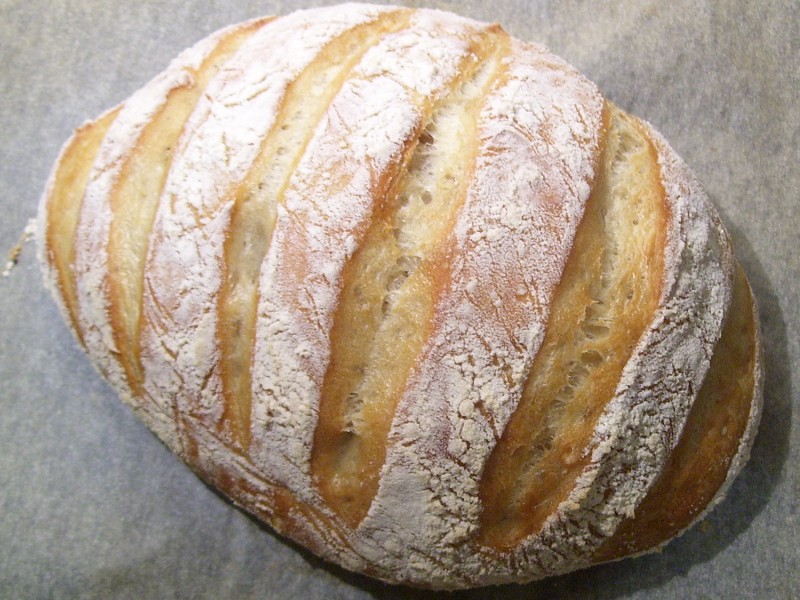
The loaves it makes aren’t huge, but enough to feed two people comfortably for lunch. They’re best eaten the day they’re made, but will keep for a couple of days. Towards the end of their life they’re probably best sliced and toasted – I find a bit of avocado on some toasted artisan bread pretty irresistible. The loaves are supposed to be round, but for some reason mine always turn out oval shaped – something to do with how I’m cutting the slashes into the top.

And did I mention that there’s no kneading involved?

Small Artisan LoafFive Minute Artisan Bread – makes 4 small loaves (or 5 12″ pizza bases)

  • 6½ c plain unbleached flour (not “high grade” – you want 10.5g -12g gluten per 100g, also, all flour in NZ is unbleached)
  • 1½ Tbsp lightly-textured salt (e.g. fine rock salt, salt flakes etc, fine table salt too fine, rock salt too rocky – roughly 25g salt) (UPDATE: I decided to experiment with iodised table salt to see what difference it made. It didn’t really make any, so feel free to use it. I used a little less, around 1 Tbsp + 1 tsp with no ill effect. If you’re worried about iodine deficiency, then it’s a good option.)
  • 1½ Tbsp dried yeast (any yeast will work including Surebake, you can reduce the amount of yeast if left to sit longer during the initial rise. I’ve been using about 2 tsp of dried active yeast.)
  • 3 c warm water
  1. In a large bowl, put warm water and yeast and stir.
  2. Add salt and flour and mix with a large wooden spoon. Should be a wet dough mixture, mix till combined – it should look rough and wet (for bread).
  3. Cover it with a non-airtight lid (e.g. lid or Gladwrap) until it rises up and then starts to flatten off and fall. This should take around two hours, but depends on the amount of yeast/ambient temperature etc. (It’s also fine if you forget about it and leave it overnight.) Then put it in the fridge.
  4. After 2 hours in the fridge (approx) it’s firm enough to handle. Sprinkle part of the top with a little flour. Grab a handful of the floured dough, pull it up then cut it off with scissors, for a lump of dough about the size of a large grapefruit.
  5. Have a bowl/baking sheet ready with some flour and drop the lump of dough into it, then “cloak”, forming into a rounded boule shape by stretching the top layer and tucking the dough underneath. It’s fine to use a bit of flour to do this.Dough Shaped Into Boule
  6. Put it on a sheet of baking paper and leave it uncovered for 40-90 mins. Flour the top, then cut six or so slashes across the top of it with a sharp knife – about 1-2cm deep.Artisan Dough With Slashed Top
  7. Place bread on a pre-heated tray (if you have a pizza stone, use it) in the middle of a hot oven (e.g. around 250°C with fan bake), with an empty oven tray beneath it (on a lower rack). As you put the bread in, add 1 cup of water to the empty oven tray. (This will cause steam resulting in a glossier finish.) Bake for around 25-30 minutes – you can check after 17 mins or so to see if the bread is cooking evenly, and turn it if not. The longer you cook it, the thicker and crispier the crust – you get a really good crust after baking for 30 minutes and after you take it out of the oven the bread will make a faint crackling sound as it cools. Smaller roll-sized loaves will still take about 20-25 minutes to bake.
  8. Allow to cool before eating.

Artisan Loaf Out of the OvenFive Minute Pizza Dough

Pizza baseDo everything exactly the same as for the artisan bread up to (and including) step 5. Then, after forming the dough into a round lump, just spread it out into a pizza base. (If you leave it on the bench for 30-60 minutes to warm up it will be much easier to roll out.) You can use a rolling pin, or just use your hands and stretch it like a real Italian. You’ll probably need to apply a bit of flour as you go to stop it from sticking. Once you’ve got the base spread out, smother it in your favourite toppings. Then bake in a hot oven (230°C) for around 14 minutes. You don’t need to wait for it to rise, just use it straight away. For a thin crust, use a bit less dough and stretch it thin. For a thicker crust do the opposite. Forget that bit about allowing to cool before eating too.