Almond Tuiles

Time saver: I still don’t know how to pronounce “tuiles” properly.

If you know what a tuile is then you already know these are delicious. If you don’t, then they’re a little difficult to explain, except to say that they’re thin, slightly crispy, slightly chewy, often curved dessert cookies. When they come out of the oven they’re quite malleable, so are sometimes shaped into bowls for ice cream etc.

I haven’t internalised the recipe for these, or come up with my own particular spin on it. When I make these, I refer to Chef Eddy, who’s got a great recipe for Almond Tuiles on his site.

The one thing I did do was halve the recipe, but I don’t think that really warrants me writing it up here. (Unless someone requests it.) So go on, go follow Chef Eddy’s advice and make them. They’re really pretty easy.

Crêpes

Time saver: Phil whips up a tasty weekend brunch…

Rolled crepeCrêpes are a traditional thin French pancake. They’re very versatile, and can be filled with just about anything for a variety of different effects. You can make them ahead of time and stack them up, or serve them hot out of the pan (my preference).

When I was growing up we probably had crêpes for lunch about once every two weeks. Mum or Dad would whip up a batch of batter, then spend the next hour frying up delicious pancakes for the starving hordes (there are lots of kids in my family). We’d eat them with a sprinkling of sugar and a dash of lemon juice, or with maple syrup, rolled up and cut into segments. When we were younger Dad would help us put them together, but it always came at a cost, because then he’d yell “Tax!” and steal one of the crispy end pieces. (In some ways I guess that represented an important life lesson.)

For that reason, I’ve always been pretty familiar with crêpes, so I was a bit surprised to find that some people consider them tricky to make. The recipe itself is very straightforward and requires relatively few ingredients and not much skill to prepare. There’s a bit of a knack to getting the batter to spread while you’re cooking them, but once you get the hang of it and get used to the idea that the first crêpe is always going to be a disaster, they’re really pretty easy.

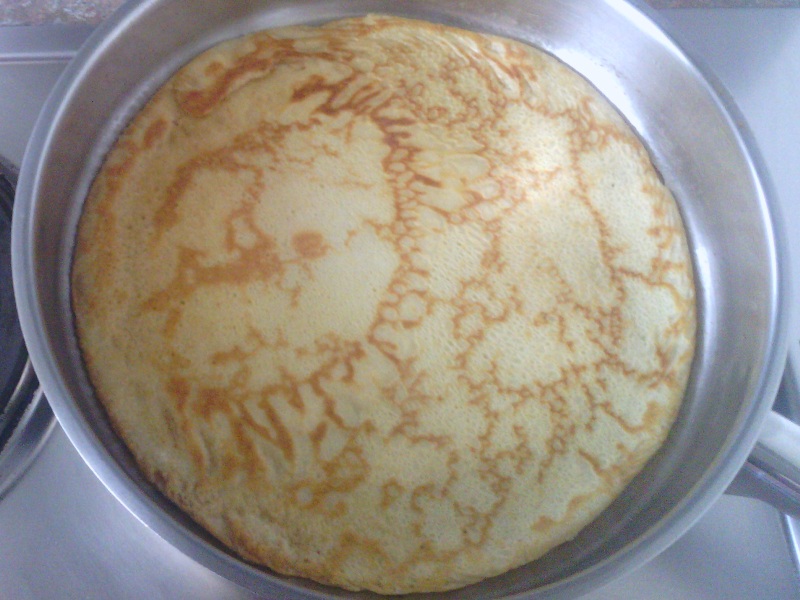
Crepe in the panI think the Edmonds Cook Book has had the basic recipe nailed for the past 100 years. They use a little less milk than my parents did – adding more helps you spread the batter and get a nice thin pancake. I’ve modified my parents’ basic recipe to scale it better for cooking for two hungry adults. The recipe can very easily be doubled or tripled etc depending on how many pancakes you’re wanting to make. I use a standard 9″ diameter frying pan to cook these in, you don’t need a special crêpe pan, and it doesn’t need to be non-stick. (Feel free to use a different pan size, just adjust the amount of batter you pour in to match.)

Crêpes – makes around 8 pancakes of 9″ diameter

  • 1½ c plain flour
  • 1½ c milk
  • 2 eggs
  • pinch of salt
  • 30 g melted butter (optional)
  • 8 small cubes of butter for frying
  1. Sift flour and salt into a large bowl.
  2. Add the eggs and milk, then beat with an electric beater till smooth. If you don’t have an electric beater, you can use a whisk or wooden spoon and a bit of arm power. In that case, you’ll want to add the milk gradually as you mix to help you avoid lumps (with the electric beater these really aren’t much of a problem).
  3. Add the melted butter and mix to combine. This is optional, particularly if you use a bit of butter to fry the pancakes in, and my parents never added it. I’m a fan of butter, and it improves the taste a bit.
  4. Put the bowl of batter in the fridge to chill for an hour (or more). This stops the crêpes from shrinking when you cook them. You can prepare the batter up to a day before you actually want to use it. If you’re in a big hurry (e.g. my parents cooking Sunday lunch) you can skip this step and cook the batter immediately, but the pancakes will contract as they cook and be slightly thicker than they otherwise would be.
  5. Take the batter out of the fridge and give it a stir. If it’s too thick add another splash of milk and stir it through.
  6. Heat a 9″ frying pan on a high heat, then reduce the heat to medium-high, and leave to settle for a couple of minutes. (My elements go from 1-6, I normally have it set to 4 when cooking these.)
  7. Put one of the small butter cubes into the pan, then lift the pan and swirl it around to spread the butter evenly over the base. (The butter will hiss and rapidly melt, this sound evokes a lot of delicious memories for me.)
  8. Pour some of the batter into the pan. I use a ladle that holds 1/3 of a cup, you could also use a 1/3 cup measure, or just pour it out of the bowl (you get a feel for how much you need). Don’t pour it directly into the middle – pour to one of the sides as it makes it much easier to spread.
  9. After adding the batter to the pan quickly lift it and tilt the pan around to spread the batter evenly. If the pan is too cold, the batter will slip and be hard to spread. If the pan is too hot the batter will cook too quickly, before you’re able to spread it. If the batter is too thick it will also be hard to spread (in that case add a bit more milk to the bowl of batter and stir it through). If you’ve used too much butter to grease the pan it will run up the sides and onto the top of the pancake – although that’s not really a problem because it just makes the edges a delicious crispy golden brown. Don’t worry if the first one turns out wrong or doesn’t spread evenly. This is your chance to thin the batter, adjust how much butter you’re using to grease the pan, or adjust the heat of the element.
  10. Cook on that side for around 1-2 minutes until the top is no longer wet. If you lift the pan and shake it slightly, the pancake should slide around. At that point, flip the pancake using a fish slice (wide spatula). If your pan has curved sides you can flip the pancake just by rapidly lifting the pan and moving it forward, up and then back towards you. It takes a bit of practice but is achievable.
  11. Cook on the remaining side for another 30-60 seconds.
  12. At this point you can serve immediately, or stack on a plate in a warm oven (90°C/200°F) to serve in one go.
  13. Return the pan to the heat for around 10-15 seconds, then add another cube of butter and repeat…

I’d then eat the crêpes, sprinkling some sugar (2-3 tsp) and a dash of lemon juice (1-2 tsp), then rolling them up tightly. Alternatively, use maple or vanilla syrup, a fresh fruit compote, vanilla ice cream etc. You can also fill them with savoury fillings, or roll them up and bake them like enchiladas.

(This morning we had them with chopped bananas and a hot vanilla-caramel sauce.)

Crème brûlée

Time saver: silky smooth deliciousness, topped with crisp toffee – what’s not to love?

I’d had crème brûlée at restaurants a couple of times before, but it wasn’t until I made them myself that I really started to love them. My sister got me a butane gas torch for making brûlée a couple of Christmases ago, and not wanting it to go to waste I thought I’d better try it out. Ever since then I’ve been hooked.

This recipe is really an amalgamation of a few different recipes I’ve come across. I’ve tweaked and adjusted as I’ve gone, and the last time I made it was the best. I’ve tried making it with fewer egg  yolks – even as low as just using 3 – but it definitely works better with more, with a better texture and richer flavour. If you do use fewer egg yolks you’ll need to cook them for longer. I’ve also tried tricks like cutting open a vanilla bean and leaving it in the cream overnight before making it. It certainly didn’t hurt, but I still needed a lot of vanilla extract anyway.

Generally speaking you’d make these the night before you want to eat them. If you really can’t wait, then go ahead and eat them the same day, but make sure you’ve refrigerated them after cooking for at least an hour or so.

One final note: use natural vanilla extract – don’t use artificial vanilla essence, it just isn’t the same. (And since you’re going to the trouble of making this decadent dessert, you’ll want to do it justice.) You can buy it, or make your own by soaking vanilla beans in vodka.

Crème Brûlée – makes 4 custards (fills 4 ramekins of around 150 ml)

  • 500ml cream
  • 6 egg yolks
  • 3 Tbsp caster sugar
  • 1-2 Tbsp natural vanilla extract (depending on strength)
  • Additional caster sugar for topping (around 1½ tsp per rammekin)
  1. Pre-heat oven to 140°C.
  2. Heat cream in a sauce pan over medium heat, stirring constantly. Cream will eventually start to boil, getting very frothy and rising in pan. When this happens, remove the pan from the heat immediately, add the vanilla extract and stir well. (Have a quick taste test to determine if you need to add more vanilla. I typically use 2 Tbsp, even with bought extract.)
  3. While cream is cooling, combine the sugar and egg yolks in a separate bowl, and whisk well. After a couple of minutes the mixture should go a pale yellow.
  4. Pour the (still warm-hot) cream into the egg mixture, whisking as you pour, and mix well.
  5. Distribute the mixture evenly among the four ramekins, then place the ramekins in a small roasting dish, and half-fill the dish with hot water (being careful not to splash your cream).
  6. Put the dish in the oven and cook for around 25 minutes. The centres should be not quite fully set, but a skewer put into the custard about halfway to the centre should come out clean. (You kind of have to use your discretion, and a lot of it comes down to your oven, the size of the ramekins, prevailing wind conditions etc.)
  7. Remove the dish from the oven, and allow to cool. Once they’re cool enough to handle, you can remove the ramekins and put them in the fridge.
  8. When you’re ready to serve, take the custards out of the fridge. Sprinkle a little sugar evenly over the tops of each one (around 1½ tsp or so), then fire up your torch. Move the flame across the surface, melting all of the sugar and caramelising it a little to get a golden brown. It takes a bit of care to make sure you don’t end up burning it, but don’t be alarmed if it’s a little darker than you were expecting.

Raspberry compote

Time saver: Phil mixes raspberries and sugar for deliciousness.

Raspberry compote is one of those things that is super easy to make but tastes awesome. For reward vs effort, it’s pretty hard to beat. It’s great on vanilla ice cream, with cakes etc. (If you’ve never had it before, it’s basically a raspberry sauce which still has large parts of the berries intact.)

This is just the basic recipe and gives a generous serving for two bowls of vanilla ice cream – if you want more, double it, triple it etc.

Rasberry compote – makes about ½ cup of compote

  • 1 cup raspberries (fresh or frozen)
  • 2 Tbsp icing sugar
  1. Put berries and sugar in a small saucepan and heat on a hot element for around 2 minutes until the sugar is dissolved. Stir occasionally but try to avoid breaking the berries up too much. The raspberries will come apart and release a lot of juice, giving you a tart red sauce.
  2. And serve. (I told you it was easy.)

For a rapberry coulis, do exactly the same, but after making the sauce, strain it through a sieve to remove seeds and berry pulp.

Lemon sorbet

Time saver: Phil cleanses your palate, and proves he doesn’t own an ice cream maker.

I used to make this all the time, until I started feeling guilty about all the sugar in it. Whatever, it’s delicous and surprisingly easy to make…

Lemon sorbet

If well beaten, this recipe makes just shy of 1 litre.

  • 2 c water (use filtered/bottled water if the tap water is chlorinated)
  • 1½ c caster sugar (plain white sugar also fine)
  • 1 c freshly squeezed lemon juice (around 6-8 lemons, more if they’re small)
  • (optional) zest of 1 or 2 of the lemons
  • (optional) 1 egg white, lightly beaten
  1. Put water and sugar in a small saucepan, and heat on hot element, stirring frequently until sugar is dissolved. If using zest, add this to the saucepan too.
  2. Let it come to the boil, and simmer for a minute or two, then remove from the heat.
  3. While the syrup cools, juice the lemons. You want around 1 c of juice, but if you’re a bit over/under don’t worry too much. Add juice to the saucepan of syrup and mix well.
  4. Pour the syrup into a freezer proof bowl – I normally just use an old 2 litre ice cream container. If you’re using zest, you could strain some or all of it out at this point.
  5. Put the bowl in the freezer. Come back in a couple of hours time, retrieve the bowl and beat with electric beaters. You can also use a stick mix quite successfully – and this will work better than beaters if you’ve over-freezed it. After beating, put it back in the freezer.
  6. Repeat the beating process a couple more times, with 30 minute to an hour long intervals, depending on your freezer. Over this time the syrup should transform to slush and then sorbet. If I’m making it overnight, I’ll generally beat it a couple of times at night, and then return in the morning, using the stick mix if it’s too frozen. (Being ice you can always just leave it out for a few minutes to melt if it’s too hard to beat.) The more you beat it, the lighter the sorbet.
  7. Lots of recipes would now have you beat an egg white through the sorbet. Doing so will make it smoother, airier and add body. It’ll also mean you have raw egg white in your sorbet, it takes all sorts.
  8. Serve in chilled glasses. For the degustation I used chilled 40ml shot glasses. If you’re serving it as the main dessert, chilled martini glasses work very well and look the business.