Five minute artisan bread

Time saver: the bread takes five minutes to make, and you want to save time?? OK, OK, Phil reveals a simple bread recipe that also doubles as a great pizza dough (and keeps for two weeks in the fridge!).
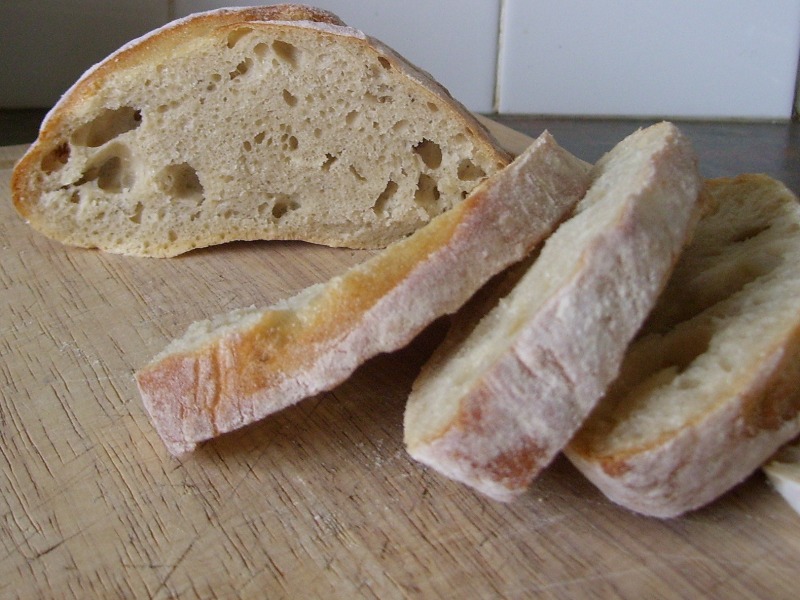
Sliced Artisan LoafWhen Mum last came to visit she raved enthusiastically about a new bread recipe she’d come across and encouraged me to make it. Actually, she’d started raving about it a couple of weeks (months?) before she arrived, so when she did she brought the ingredients with her and whipped up a batch in no time. And just as she’d claimed, the results were pretty impressive.

Mum didn’t invent the recipe, and neither did I – it “originates” here – but this is the version that Mum dictated to me from memory, with some minor edits by me. (I put originates in quotes because it’s a pretty simple bread recipe involving just four ingredients, and people have been eating bread for thousands of years. The odds of these guys having uniquely stumbled across this particular combination are pretty slim. There’s a separate discussion here that we’ll have to get into sometime – who owns/invents a recipe? At what point have you made enough changes to a recipe to call it your own? Most recipe books really just contain versions of existing recipes, and a pretty big part of cooking is reproducing things people can recognise, so there’s an awful lot of copying and duplication going on.)

The basic idea with this bread is that you mix up a dough, leave it to rise for a couple of hours, then stick it in the fridge where it will keep for up to two weeks. Whenever you want a loaf of bread you grab a lump of dough, let it rise for a bit then bake it. Voila, fresh bread. And as I’ve mentioned previously – the dough can also be used for pizza bases on demand. (Don’t underestimate the brilliance of this feature. Stuck for dinner ideas? Bust out some dough and whip up a pizza or calzone in no time.)

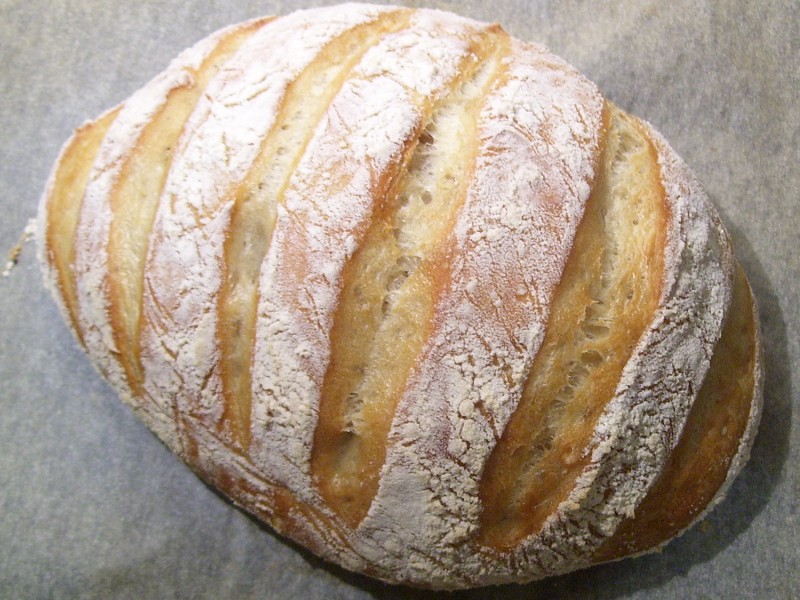
The loaves it makes aren’t huge, but enough to feed two people comfortably for lunch. They’re best eaten the day they’re made, but will keep for a couple of days. Towards the end of their life they’re probably best sliced and toasted – I find a bit of avocado on some toasted artisan bread pretty irresistible. The loaves are supposed to be round, but for some reason mine always turn out oval shaped – something to do with how I’m cutting the slashes into the top.

And did I mention that there’s no kneading involved?

Small Artisan LoafFive Minute Artisan Bread – makes 4 small loaves (or 5 12″ pizza bases)

  • 6½ c plain unbleached flour (not “high grade” – you want 10.5g -12g gluten per 100g, also, all flour in NZ is unbleached)
  • 1½ Tbsp lightly-textured salt (e.g. fine rock salt, salt flakes etc, fine table salt too fine, rock salt too rocky – roughly 25g salt) (UPDATE: I decided to experiment with iodised table salt to see what difference it made. It didn’t really make any, so feel free to use it. I used a little less, around 1 Tbsp + 1 tsp with no ill effect. If you’re worried about iodine deficiency, then it’s a good option.)
  • 1½ Tbsp dried yeast (any yeast will work including Surebake, you can reduce the amount of yeast if left to sit longer during the initial rise. I’ve been using about 2 tsp of dried active yeast.)
  • 3 c warm water
  1. In a large bowl, put warm water and yeast and stir.
  2. Add salt and flour and mix with a large wooden spoon. Should be a wet dough mixture, mix till combined – it should look rough and wet (for bread).
  3. Cover it with a non-airtight lid (e.g. lid or Gladwrap) until it rises up and then starts to flatten off and fall. This should take around two hours, but depends on the amount of yeast/ambient temperature etc. (It’s also fine if you forget about it and leave it overnight.) Then put it in the fridge.
  4. After 2 hours in the fridge (approx) it’s firm enough to handle. Sprinkle part of the top with a little flour. Grab a handful of the floured dough, pull it up then cut it off with scissors, for a lump of dough about the size of a large grapefruit.
  5. Have a bowl/baking sheet ready with some flour and drop the lump of dough into it, then “cloak”, forming into a rounded boule shape by stretching the top layer and tucking the dough underneath. It’s fine to use a bit of flour to do this.Dough Shaped Into Boule
  6. Put it on a sheet of baking paper and leave it uncovered for 40-90 mins. Flour the top, then cut six or so slashes across the top of it with a sharp knife – about 1-2cm deep.Artisan Dough With Slashed Top
  7. Place bread on a pre-heated tray (if you have a pizza stone, use it) in the middle of a hot oven (e.g. around 250°C with fan bake), with an empty oven tray beneath it (on a lower rack). As you put the bread in, add 1 cup of water to the empty oven tray. (This will cause steam resulting in a glossier finish.) Bake for around 25-30 minutes – you can check after 17 mins or so to see if the bread is cooking evenly, and turn it if not. The longer you cook it, the thicker and crispier the crust – you get a really good crust after baking for 30 minutes and after you take it out of the oven the bread will make a faint crackling sound as it cools. Smaller roll-sized loaves will still take about 20-25 minutes to bake.
  8. Allow to cool before eating.

Artisan Loaf Out of the OvenFive Minute Pizza Dough

Pizza baseDo everything exactly the same as for the artisan bread up to (and including) step 5. Then, after forming the dough into a round lump, just spread it out into a pizza base. (If you leave it on the bench for 30-60 minutes to warm up it will be much easier to roll out.) You can use a rolling pin, or just use your hands and stretch it like a real Italian. You’ll probably need to apply a bit of flour as you go to stop it from sticking. Once you’ve got the base spread out, smother it in your favourite toppings. Then bake in a hot oven (230°C) for around 14 minutes. You don’t need to wait for it to rise, just use it straight away. For a thin crust, use a bit less dough and stretch it thin. For a thicker crust do the opposite. Forget that bit about allowing to cool before eating too.


New York Style Pepperoni Pizza

Time saver: Phil saves you a trip to Manhattan (well, Sal’s at least).

New York Style Pizza SliceIf you haven’t had Sal’s authentic New York pizza, and you live in Auckland, you should go and have some. It’s $5 for the first slice, and $4 thereafter, and unless you’re some kind of insane eating machine that means it’ll cost you $9 to feel satisfyingly bloated and full. Once you’ve done that, you can cut out the middle-man, and make this instead (but at least you’ll know what you’re aiming for). A couple of years ago I probably would have turned my nose down at this pizza – thinking it’s not-very-complicated topping lacked interest. Now that I’ve tasted it, I’ve seen the light.

Unlike my last pizza, I’m going to go ahead and say that home-made pizza dough is a must. Bought bases save time, but since there’s really not much to this pizza you have to make sure everything is premium, and I’ve never seen a pre-made base that would do it justice. Likewise, with my last pizza I was happy to use cheddar cheese, with this one I’m saying mozarella all the way.

New York Style Pepperoni Pizza

  • 12″ pizza base (home-made, medium-thin with slightly higher edges)
  • 3 Tbsp tomato paste
  • 1 Tbsp olive oil
  • 1 clove or ½ tsp crushed garlic
  • freshly ground black pepper and salt
  • 1-2 c grated mozarella (125g is roughly 1 cup when grated)
  • 100g good quality pepperoni, sliced
  1. Pre-heat oven to 230°C (about 450°F). If you’ve got a pizza stone, use it, otherwise just put one of your trays in to heat.
  2. Roll out/manhandle pizza base to a 12″ circle, then place on a sheet of baking paper. The base should be thin in the centre, and slightly raised around the edges.
  3. In a small bowl, combine the tomato paste, olive oil and garlic, mix well.
  4. Spread tomato paste over pizza base, going right to the edges.
  5. Crack some black pepper and salt over the base, then sprinkle with cheese. Leave a centimetre or two clear around the edges. For a real New York pizza, use about 150g of grated mozarella to get that mottled, not-quite-cheese-covered look.
  6. Spread pepperoni slices over the cheese – they’ll shrink a bit when cooked.
  7. Put the pizza in the oven (with baking paper) on your pre-heated tray/pizza stone. Cook for 14 minutes or so, until the base is cooked and the cheese is melted and golden.

Whole New York Style Pizza

Tuna melt parcels

Time saver: Phil riffs on an old favourite with pastry. Cat is impressed.

Tuna melt parcels - with egg washSo last night I was making Spicy Pumpkin Soup and got hungry. You’d think that was the point of the soup, but for whatever reason I decided to make these as the soup simmered away.

Tuna melts are simple and tasty. Bread, tuna, cheese, a bit of pepper and a sandwich press are all it takes for a winning combination. But what if you don’t have bread? (Regular readers might wonder why I didn’t just whip up some artisan bread, but remember I’m using the stockpot I make the bread in to make soup, pay attention people.) Branching out I had no choice but to reap the health benefits of flaky puff pastry. Long term studies have repeatedly shown that flaky puff pastry is delicious and I guess the less said about the rest of it the better.

For the parcels I wanted to do a bit more than just tuna and cheese, so I whipped up a cheese sauce, threw in some blue cheese and then added the tuna to that. If blue cheese doesn’t appeal, stick with cheddar. If you want to make it a bit healthier, add some brocolli or spinach to the sauce.

One final point – tuna fish stocks are currently in danger of being depleted. With some species more badly affected than others. The situation will obviously change with time, but I think Pacific-caught Skipjack Tuna is currently OK. (While there’s a part of me that wants to say “It’s running out, make the most of it while you can”, I don’t think that’s really a position I can endorse. It would be a tragedy to overfish to a point where tuna can’t recover, and being aware of what you’re eating is what home cooking is all about.)

Tuna melt parcels – makes 4

  • 185g tin tuna chunks in spring water, drained
  • 2 square sheets flaky puff pastry
  • 1 Tbsp butter
  • 1 Tbsp flour
  • ½ c milk
  • freshly ground black pepper
  • 80-100g (about 1 c) grated cheddar, or 40-50g (½ c) cheddar and 40-50g blue cheese
  • 1 egg + 1 Tbsp water for an egg-wash on the pastry, or just use milk
  1. Pre-heat oven to about 200ºC.
  2. Melt butter in a small saucepan over a medium heat.
  3. Add flour to make a white roux. Stir well to combine and keep from catching on the bottom. Cook for around 1-2 minutes.
  4. Gradually add the milk and stir well with each addition to avoid lumps. Stir with a wooden spoon or whisk.
  5. After adding all the milk you should have a reasonably thick white sauce. Season with black pepper, then add the cheese, stirring thoroughly until it’s all melted.
  6. Add the tuna chunks (and any vegetables – strictly optional) to the sauce, and stir to combine.
  7. Cut each of the pastry sheets in half (giving you four long rectangles of pastry). Decide which end will hold the filling, then stab through several times with a fork. (This is to stop big pockets of air forming, causing the pastry to rise and push out the filling.) Don’t be afraid to get mean with it, but avoid putting any holes within about 1 cm from the edges.
  8. Put 4 Tbsp of the tuna filling in the centre of each of your fork-stabbed bases. Use a little water to wet the edges, the fold the (unstabbed) top half over and press down. Seal by pressing down on the sides with a fork. Make a couple of holes in the top of each parcel with a fork.
  9. Transfer the four parcels to a baking tray (lined with baking paper if you want to make it easier to get them off/clean up). If using an egg-wash, lightly beat an egg with 1 Tbsp of water then brush on to any visible pastry. (You won’t use even close to all of the egg wash. Maybe feed it to the cat, or make a miniature omelette.) If using milk brush that on instead.
  10. Bake in oven for around 15-20 minutes until the pastry is golden-brown.

Cooking tuna melt parcels - montage

Spicy Pumpkin Soup

Time saver: Phil gets cold, busts out the soup.

Two bowls of spicy pumpkin soupIt’s been a few days between posts, but never fear – I haven’t stopped cooking. In fact I have a bit of a back log of recipes to write up, so hopefully my ambition is matched by motivation.

We’ve had some pretty bad weather over the last few days, and winter seems to have really set in. When it gets cold there’s nothing quite like a bowl of hot soup, so bust out the stock pot and let’s get cracking.

Just a quick note about the pumpkin. I’m really sorry, but I’ve never weighed it. If you think a large pumpkin is one that wins prizes at country fairs then you’ll probably want to go with half a small pumpkin. Also, if you’ve got the time and the inclination, you’ll get a richer flavoured soup if you roast the pumpkin first. If you’re short on time or just can’t be bothered, then don’t worry about it. Note that if you do roast it, the actual time to prepare the soup will be less. So you could roast the pumpkin the night before, and then make a fresh hot soup pretty quickly the next day. If that’s your thing.

Spicy Pumpkin Soup – serves 4-6

If roasting the pumpkin, heat oven to about 220°C-230°C. Put pumpkin chunks in a roasting dish, pour in a couple of Tbsp of oil (I used peanut oil for a bit of flavour, but olive oil or whatever you have handy is fine) and mix the pumpkin around to get it evenly coated. You can season it if you like, but you’ll need to adjust the soup seasoning accordingly. Roast for 15 minutes, then give the pumpkin a bit of a stir around, reduce heat to 200°C and roast for another 15 minutes.

  • ½ medium-large pumpkin, peeled and chopped into smallish chunks
  • 1 large onion, peeled and diced
  • 3 celery stalks, sliced into crescents (if you don’t have celery handy, just use another onion)
  • 1 tsp or 2 cloves crushed/finely chopped garlic
  • 1 litre liquid chicken or vegetable stock (if you don’t have it you can use powdered stock, 1 tsp per 250 ml) + additional stock/water if required
  • 1½ tsp ground cumin
  • 1 tsp mixed spice
  • 2 Tbsp oil/butter
  • salt and freshly ground black pepper to taste
  • sour cream/unsweetened plain yoghurt/greek yoghurt
  • chopped parsley to garnish
  1. Heat oil/butter in large stockpot over a medium-high heat.
  2. Add onion, celery and garlic to pot and cook till clear (around 3-5 minutes).
  3. Add pumpkin, stock, cumin and spice and stir thoroughly.
  4. Bring to the boil, then reduce heat and simmer until the pumpkin is soft and cooked through. (If using roasted pumpkin, simmer for 5-10 minutes, if using raw pumpkin this takes around 30-60 minutes.)
  5. Blend soup till smooth, either by blending it in batches or (carefully) with a stick mix/hand held blender. If the soup is very thick you can add more stock or just add water.
  6. Season with ground black pepper and salt, to taste.
  7. Serve with toasted/warm bread. Add a generous dollop of sour cream/plain yoghurt to each bowl, and garnish with a sprinkling of fresh chopped parsley.

Bowl of spicy pumpkin soup

Croque-croissant

Time saver: if you like a ham and cheese croissant, you’ll probably like this.

First things first: this isn’t a recipe for croissants – I’ve never even attempted to make them, for a couple of reasons: firstly, it’s a lot of work, and secondly, seeing how much butter goes into them might put me off eating them. Sometimes it’s nice to keep a few things you don’t make just so you can enjoy them when you’re out. (Sushi also falls into this category for me – although I think making it is less involved than making croissants.)

I’m not sure if a croque croissant is an actual thing in France. They might just be for foreigners and the French may consider them some sort of travesty. Who knows? A local French deli (Pyrénées – if you’re in Auckland and you like French food I highly recommend it) sells these and I love them. It’s really just a “Croque-monsieur” (these are definitely a thing in France) but made with a croissant rather than two slices of bread.

The basic concept with a croque-anything is some kind of bread with ham, cheese, and bechamel (white) sauce, put together then grilled (broiled) to perfection.

As you may have guessed, since I don’t make my croissants I have to buy them. You could use supermarket croissants (some are better than others) but if you’ve got a French bakery (or really, any bakery) nearby it’s probably worth picking them up from there. Another good option is to get frozen  croissants and use those. (For some reason the Asian Food Warehouse in Christchurch used to have an awesome deal on these, I think sourced from the French Bakery. Unfortunately the food warehouse is out of commission because of the earthquake, but they may return.)

Here’s the recipe, pictures to follow…

Croque-croissant – makes 4

  • 4 medium sized croissants (already baked)
  • 100-200g shaved ham
  • ¾ c milk approx – for a thick white sauce (or ½ c milk and ¼ c cream for a richer creamier sauce)
  • 2 Tbsp plain flour
  • 2 Tbsp butter
  • 1 tsp Dijon mustard
  • freshly cracked black pepper and salt to taste
  • 4 slices cheddar cheese for tops (use Gruyère if you have it)
  1. Melt butter in a small saucepan over a medium heat.
  2. Add flour to make a white roux. Stir well to combine and keep from catching on the bottom. Cook for around 1-2 minutes.
  3. Gradually add the milk and stir well with each addition to avoid lumps. It’s most likely to go lumpy if you add too much milk in one go at the beginning. You can use either a wooden spoon or a whisk for mixing.
  4. When you’ve added all the milk, remove from heat. You should have a very thick white sauce. Add the Dijon mustard (if you’re not a fan, use a ½ tsp, or leave it out altogether), cracked black pepper and salt to taste and mix well.
  5. Cut an opening along one side of each croissant to allow you to fill them.
  6. Spoon about 2 Tbsp of the Bechamel sauce into each one, spreading within the croissant.
  7. Divide the shaved ham into four, and put a layer on top of the sauce in each croissant, then push the croissants closed.
  8. Put another Tbsp of Bechamel on top of each croissant, spreading slightly, then place a slice of cheese on top of this.
  9. Grill/broil in the oven until the cheese has melted and gone golden, then serve.